

Ten years ago, I was sitting in the library of Fuller Theological Seminary reading a commentary on the New Testament letter, Philemon (as one does), when I got the idea to write a novel telling a backstory to the letter.
This moment marked the beginning of my fiction-writing journey: I didn’t decide to become a writer and then go looking for stories; rather, a story found me, and I had to write it.
I tunneled into scholarship on the letter, and on the culture, geography, and history of ancient Turkey. But more than research, I had to wrangle fiction—a nine-headed hydra wholly different from the essays of my 14-year saga as a grad student in theology and philosophy. I took fiction-writing courses, I attended workshops, I read craft books, and I hired editors to critique my work. I built my boat while sailing it.
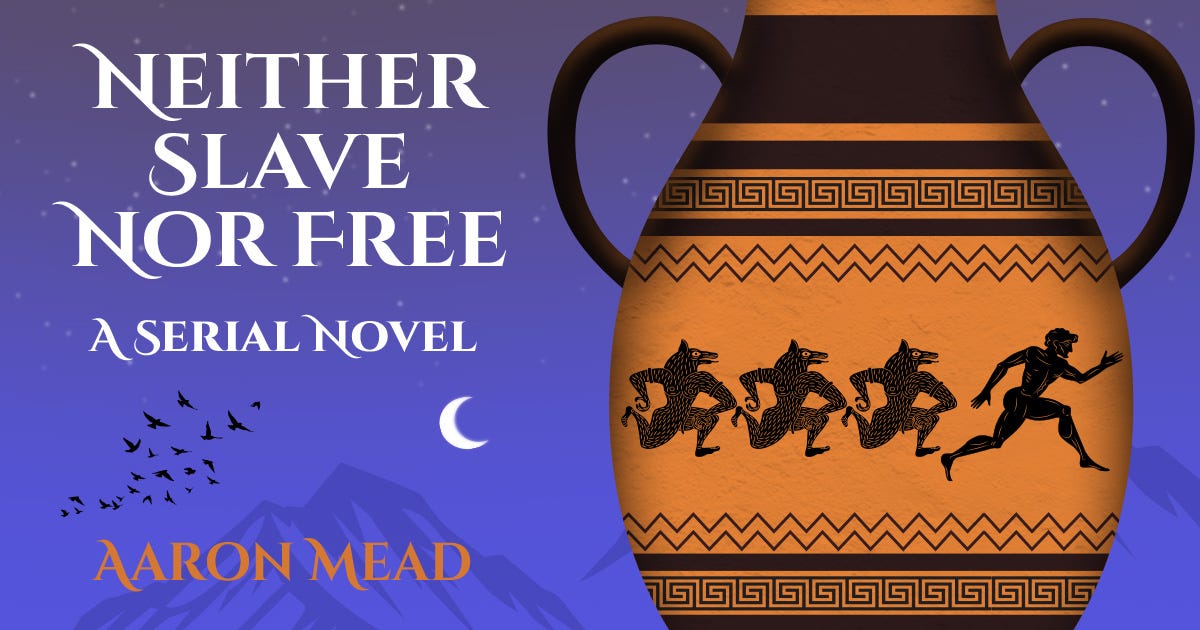
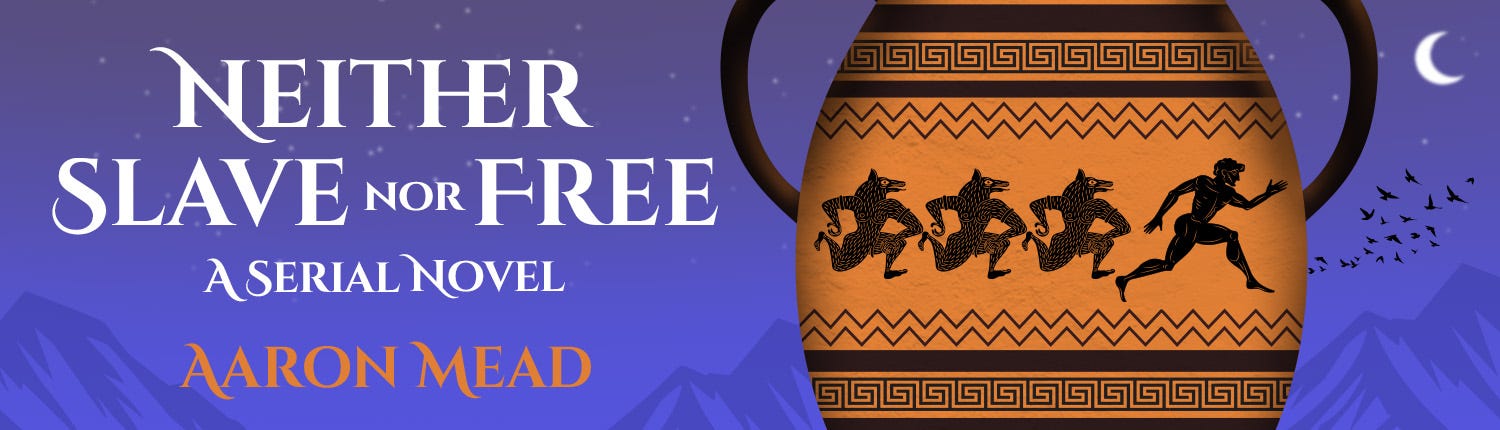
Now, ten years on, the novel is complete, and I plan to roll it out serially—chapter by chapter, week by week—on my Substack publication, sub·plot. I’ve scheduled the first chapter for Sunday, June 21st, 2026. Below is a preview of the cover art (thank you, Shirleen Chang!), a short blurb, and two endorsements from early readers.
Risking crucifixion, Onesimus, an enslaved shepherd, flees his bitter half-brother and master, Philemon, only to find that freedom requires more than mere escape.
“. . . a masterful grasp of the cultural, political and spiritual context of the time . . . The heart of the novel beats for hope, and asks one essential question: what does it mean to truly be free?” —Claire Gibson, author of the novels Burst Into Song (forthcoming) and Beyond the Point
“. . . one of the best historical novels I’ve ever read on a New Testament figure . . . Mead’s novel utilizes cutting edge scholarship as he weaves a beautiful and inspiring story of hope and faith.” —Demetrius K. Williams, Professor of Comparative Literature and Religious Studies, University of Wisconsin-Milwaukie; Editor of Onesimus Our Brother: Reading Religion, Race and Slavery in Philemon
Serial Fiction: The Push
So why publish the novel serially? I’ve felt both a push and a pull to do so.
First, the push: agents and traditional publishers haven’t caught my vision. But I don’t think that’s because the novel falls short. The two professional editors I worked with over the years both said it’s one of the best indie novels they’ve read, and they could easily see it in a bookstore. So why no joy with traditional publishers?
First, the book straddles genres: publishers might view it as either “Christian fiction” or literary-historical fiction, depending on which they publish. In fact, my guess is they’ve concluded it belongs to whichever genre they don’t publish (sigh). For example, given the overt (though I hope still tasteful) biblical and theological themes of the book, I imagine literary-historical folks view my project as “too Christian” for them.
But the book also isn’t “Christian fiction.” In my (wholly unscientific) assessment, that genre generally amounts to romance by another name—which does not smell as sweet. These “clean” romances tend to extol terrible values, chief among them the subservience and sexual repression of women. Beth Felker Jones’s post, below, represents my worries.

Worse, traditional Christian publishers don’t do much fiction in the first place—the Christian book market has always been dominated by non-fiction. (Reason: Christians care about truth, and fiction is false, right? I’ve rolled my eyes so hard they may be stuck.)
This non-fiction bias means Christian publishers push fiction writers into a non-fiction marketing mold, requiring a large, ready-made audience (a “platform”) before publishing. And I don’t fit that mold.
There are some literary novels that directly engage biblical themes and settings without falling into the “Christian fiction” genre. Frederick Buechner’s The Son of Laughter and Sue Monk Kidd’s The Book of Longings come to mind. But such books are rarely debut novels. Before The Son of Laughter, Buechner published A Long Day's Dying. Before The Book of Longings, Monk Kidd published The Secret Life of Bees.
The upshot is that both secular and Christian publishers tend to view my kind of project—a debut, biblical, theological, literary, historical novel—as radioactive. My conclusion: if the story is ever to escape my hard drive, I’ll have to go non-traditional. That’s the push.
Serial Fiction: The Pull
The pull is that serial fiction in digital format is attractive right now. It’s at once both new and old, reclaiming a vintage format in a shiny new-tech wrapper.
As Kevin Kelly observes in his article, “Everything I Know about Self-Publishing,” reading, in our culture, has lurched away from pages and toward pixels. Perhaps as a consequence, our cultural attention span has shrunk, and we tend to read shorter. Kelly writes,
“In general, people devote less time to books because of the huge amount of attention they require. It is easier to string that attention out in an ongoing series of posts.”
Perhaps for this reason, serial fiction is having a moment on Substack. Writers like Simon K Jones, Orna Ross📚, S.E. Reid, and Erica Drayton are all publishing fiction this way.
At the same time, serial fiction reaches back to the roots of the novel. As Orna Ross 📚 notes in her article, “How to Read a Serialized Novel on Substack,” many writers in the literary canon first published their novels serially in journals and magazines, including Charles Dickens, George Eliot (Mary Ann Evans), Fyodor Dostoyevsky, and Harriet Beecher Stowe.
Reading serially allows for story marination between chapters, deeper thinking about the subject matter, and greater anticipation. In this way, it’s a kind of resistance to our culture of haste and maybe even a tool to slow or reverse the shriveling of our phone-addled attention spans. That’s the pull.
Nuts and Bolts
So how will it work? Beginning on June 21st, 2026, I’ll post a chapter to sub·plot every Sunday. If you’re already on my email list, the chapters will just show up in your inbox, like this one did.
Since the book is 6,000 pages long, . . . kidding! It’s actually around 400 pages—standard for a historical novel. I’ll post it in 54 chapters, averaging six to eight pages each (1,500-2,000 words). Your attention span can totally do this.
For now, all posts will be free. With that said, if you enjoy the story, I would ask two things of you, faithful reader:
Consider becoming a paid subscriber to support my work and help raise money for a physical book launch (some of us still read long and on paper!). It’s only $5/month.
Consider telling someone about the novel if you think they’d like it, too.
For the Binge-ers Anonymous crowd, at certain breakpoints in the story I’ll collect the already-posted chapters into e-books available for purchase, so you can get your fix (no judgement!). The e-books will be free to paid subscribers.
For those who listen to their fiction, I’m recording audio of each chapter, to be accessible at the top of each post and through a podcast on the normal channels (Spotify, Apple, etc.).
I’ll also post occasional essays that give background on the novel and my ten-year journey of writing it. With weekly chapters and these essays, subscribers will get a few more emails from me than normal (!). If your inbox overfloweth, you can opt out of particular email types here. (I’ll include that link in each post too.)
Navigating a serial novel on Substack is a little trickier than reading a book, so I’ve made a “Table of Contents” to orient and reorient you if you get lost. There’ll be a link to that page in every chapter, so you can always find your way back.

Finally, thanks for joining me on this writing journey. Solo-screaming into the void has its place, but I prefer doing it with friends. :) Seriously, your support means a lot to me, and I hope this next leg of the journey—into serial fiction—is engaging and encouraging for you. As always, I’d love to hear from you. Leave a comment or drop me a message any time. I promise to get right back to you.
Your insights — on “Christian” romance, on the often-naive claims about “non-fiction” being more truthful, and about the divided world of “Christian”/non-Christian publishing — hit me as both revelatory and at the same time so clearly true. I like your approach and am interested in reading your serial novel.
Aaron,
I feel very seen as another literary Christian novelist — there doesn’t quite seem to be a clean fit anywhere. You’ve described the dilemma very well. I too am serializing my novel, a literary leaning novel with overt Christian themes, but packaged in a classic coming-of-age story (which takes place over the course of a summer at a camp).
I’m excited to subscribe and follow along and would like to invite you to check out how my serial has been going!