

This post is a chapter of Neither Slave nor Free, a serial novel that tells a literary-fictional, historically-plausible backstory to the New Testament letter, Philemon. New chapter every Sunday. Listen to it on Spotify or Apple Podcasts.
Risking crucifixion, Onesimus, an enslaved shepherd, flees his bitter half-brother and master, Philemon, only to find that freedom requires more than mere escape.
“. . . a masterful grasp of the cultural, political and spiritual context of the time . . . The heart of the novel beats for hope, and asks one essential question: what does it mean to truly be free?” —Claire Gibson, author of Beyond the Point: A Novel
“. . . one of the best historical novels I’ve ever read on a New Testament figure . . . Mead’s novel utilizes cutting edge scholarship as he weaves a beautiful and inspiring story of hope and faith.” —Demetrius K. Williams, Professor of Comparative Literature and Religious Studies, University of Wisconsin-Milwaukie; Editor of Onesimus Our Brother: Reading Religion, Race and Slavery in Philemon
“Through characters that are vividly complex, defying any easy, moralizing categorization, Mead delivers a thrilling piece of historical fiction that sheds needed light on a tiny letter whose controversial impact has been, and remains, gargantuan.” —Tommy Givens, Associate Professor of New Testament Studies, Fuller Theological Seminary
Want a different chapter?
Enjoying the story? Subscribe or upgrade to paid.
Customize which emails you receive here.
Story Recap
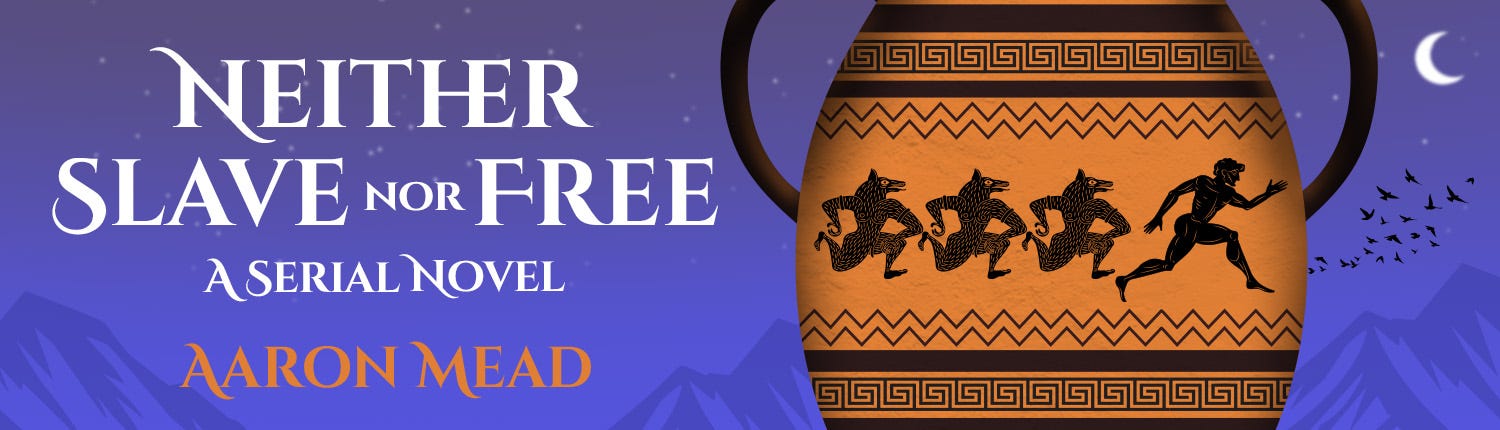
Onesimus and his fellow enslaved shepherds lead their flock down from summer pastures in the mountains to the villa of Onesimus’s deceased father, Pater, near Colossae, in the ancient Roman province of Asia. Onesimus expects to be freed by the terms of his father’s will, and he plans to resist serving as a freedman to his hateful half-brother, Philemon, heir of Pater’s estate. The shepherds encounter wolves on their way down the mountain, prompting Onesimus to remember last night’s dream about the goddess, Artemis.
The next day, at the seventh hour, just after midday, Onesimus and Neos set off for the funeral procession down the two-mile road from the villa to Colossae, parallel ruts carved in dirt by a thousand ox-drawn carts. A feast would follow. And the reading of the will. Onesimus walked in one rut, Neos in the other, a median of scruffy grass between them. They ambled downhill through a stand of pine trees, gnawing hard barley bread. As they emerged from the trees, the road flattened onto the floodplain, allowing a view of Colossae’s citadel, which perched on a hill overlooking the river to the north. They crossed through winter-barren vineyards, fruitless orchards, and empty olive groves. Against a backdrop of raucous birdsong, the only sounds were the shepherds’ chewing and their dusty footfalls. A bank of slate rain clouds stole up the valley, and behind them Mount Cadmus wore a layer of mist.
They crossed the intersection with the trunk road, which led east through the mountains, a six-day walk to the cities of Galatia, and west down the valleys to Ephesus. They entered the southern gate and started up the hill. Cramped three-story tenement blocks clung to the city walls like honeycomb. The smell of woodsmoke, fresh bread, and incense mixed with undertones of excrement and garbage to produce a pungent cocktail. A trio of Jewish men in tasseled simlah strode past, returning from afternoon prayer.
As they crested the hill and passed the marble temple at the crossroads, Onesimus’s heartbeat quickened. The doorstep of freedom, he thought. He uncorked his wineskin and took a long drink of bad wine, which puckered his face. He hoped for better at the feast. Ahead, a crowd dressed in black gathered in the street outside Pater’s domus, his house in town—now Philemon’s domus, Onesimus corrected himself. Trumpeters, cornu players, and a choir of ten men headed the procession, followed by twenty professional mourners, all women. Behind them, five masked actors, one dressed as a soldier, playing Pater, and the others in traditional clothing, standing in for ancestors—a welcoming committee from the underworld. After the actors came a cohort of some thirty slaves and freedmen, assembled from both the villa and the domus, many carrying flower garlands.
As Onesimus and Neos drew alongside the slave contingent, two house slaves looked at them askance: the shepherds were every bit country slaves, their shaggy hair and wild beards untended since arriving from the mountains, far exceeding the trim mourning beards worn by some of the male house slaves. Onesimus returned a hostile look. How dare they lord it over a son of the deceased, a son of the paterfamilias. Soon they’d hardly look him in the eye. He pushed in front of them, still glaring, and pulled Neos into formation.
Just then, the double front doors of the domus swung open, and two house slaves emerged with a bier bearing the dead man, clothed in military uniform. Two handles at each end of the bier rested on the slaves’ shoulders, elevating the body for display. As they carried it to the street, Apphia, Onesimus’s mother, and Monica, Philemon’s wife, emerged from the domus, arm in arm. Philemon followed close behind, his face grizzled and his bulky body wrapped in a black toga and cloak. If not for his middle-aged gut, Philemon could have passed for a gladiator: broad shoulders, bulbous calves, cruel hands. After Philemon came a train of family friends, military comrades, and members of the civic council on which Pater had sat, several tottering and lurching, already drunk.
Onesimus watched the dignitaries take up posts at the rear of the procession, behind the bier. His brother held his head high, his gaze fixed and distant. His eyes looked hard, with no trace of grief. Heartless, thought Onesimus, then felt a twinge in his stomach, guilt at his own lack of grief. Since he’d learned of it, Pater’s death had seemed only an opportunity, a path to freedom, but now he was struck with the bare truth: his father was dead. This fresh perspective also bore no sadness, deepening his guilt.
His mother caught his eye and beckoned him. For the somber occasion, her silvered-brown hair was around her shoulders, not wound in a workaday bun. Onesimus left Neos and made his way to the back of the procession. He passed the bier, and repellent hints of the eight-day corpse, barely masked with myrrh, drifted to his nostrils. Apphia left the procession to meet him. “Your beard is unkempt,” she said, advancing on him. “Why didn’t you trim it?”
“We just got back last night,” he said.
“Your father is dead.” The corners of her mouth creased in a frown, and her fierce eyes glittered like blue gemstones. “You should have trimmed it.”
“Enough, woman,” said Onesimus, stepping back and glancing around, embarrassed.
She wiped shaky hands on her tunic, and then reached out, embracing him and kissing both his cheeks. Did she smell of wine? He’d known her to drink only rarely apart from feasts and rituals. She’d always said Pater drank enough for them both. She forced a smile, and her wrinkles deepened. “I missed you,” she said, but then reverted to commands: “Walk with me.”
Onesimus nodded, on his guard, conscious of Philemon’s eyes on him. Apphia pulled him into line with her. She looked smaller than in the spring, before they’d left for the mountains. Thinner, weaker. The dark half-circles under her eyes spoke another plain fact he’d overlooked: his mother had lost not only her master but her lover. Might as well have been her husband; while she was his, he’d had no wife. “How are you?” said Onesimus, softening.
“I’m well,” she said, forcing another half-smile, avoiding his eyes.
Onesimus felt a hard double tap on his shoulder from behind. He turned to see his hulking brother, brow furrowed, looking down at him. Philemon’s full cheeks had begun to sag over his jawline, the beginning of jowls. Face of an aging woman, thought Onesimus. A stark contrast with the square jaw Onesimus had inherited from Pater.
“This is not your place,” said Philemon, his voice icy.
Onesimus looked at him with a blank face.
“With the slaves,” said Philemon, his cadence slow, his voice loud, as if teaching an idiot, gesturing toward the front of the procession with a hand like a club.
Onesimus’s stomach twisted, and his face flushed. Not even a moment with his bereaved mother. Why shouldn’t he walk at the rear with the dignitaries? He was the man’s son, about to be a freedman.
“He’s Pater’s family,” said Apphia, irritated. Then more gently, “He’s your brother.”
“Is he?” said Philemon. He looked at Onesimus, boring in with his eyes. “To the front.”
“What about her?” said Onesimus, nodding at Apphia, barely veiling his anger. His mother looked embarrassed. If he was still a slave, then so was she.
Philemon clenched his jaw but said nothing, again pointing to the front of the procession, cracking the knuckles on his other hand with his thumb.
Onesimus looked Philemon in the face. “Not for long,” he said.
Philemon narrowed his eyes. “What’s that supposed to mean?”
Onesimus stared back at him. “You’ll see.”
Philemon’s face went red, and he made fists. “Get with the slaves, or I’ll knock you there!”
Onesimus finally obliged, turning and strolling toward Neos and the other slaves, but he kept his head high. Despite his thumping heart and racing guts, he’d go in his own way. If Philemon were to be his master, it would be but a temporary arrangement, a mere formality until Onesimus was freed according to the terms of his father’s will. And he had reason to think he’d avoid such an arrangement entirely, being freed directly by the will. Either way, why give Philemon ready obedience?
The procession staggered into motion, heading for the necropolis north of the river. The trumpets, cornua, and choir began their music; the professional mourners shrieked and gyrated, tearing out clumps of hair and tossing them on the ground, gouging their forearms and cheeks with sharp fingernails, leaving bloody traces in the skin. As a member of the Fellowship of the Crossroads Temple, Onesimus had attended many funeral processions. They were all the same. The mourners would rip and tear at themselves, feigning deepest grief, then collect their wage, lick their wounds, and regrow their hair in time for the next procession. He took another swallow from his bitter wine as he began to walk, then absently picked a scab on his own forearm.
He remembered a night when he was ten. He’d slept on his mother’s wide couch, the one they’d shared when she stayed at the villa. During the third watch of the night, he woke to the sound of someone fumbling with the door handle. He nudged her awake, and they both sat up as the door swung open. Pater stumbled in, reeking of wine, his breath heavy and loud, eyes glazed. Onesimus stayed seated, trembling, but his mother stood and faced him. “I’m with the boy tonight,” she said. Her voice was gentle.
He ignored her words and came at her, pawing the neckline of her nightshirt, pulling it over her shoulder, eyes fixed on her covered breasts.
Apphia stepped back, avoiding his clumsy hands, and slipped the nightshirt back on her shoulder. “You shouldn’t be here,” she said, this time her voice firm.
Anger clarified Pater’s eyes. He lurched toward her, a bear awakened from slumber, grabbed her round the waist, and pressed her against his torso.
“You’re hurting me,” she said, wriggling free of his grasp, again fading backward.
Pater stripped off his cloak and tossed it in the corner and did the same with his tunic. He stood naked except for a loincloth and sandals, his thick bare chest reflecting blue in the moonlight that filtered through the open shutters. Again, he went for her, this time catching her wrist in a tight grip.
She cried out and slapped his face with her free hand.
He grabbed her other wrist and put his face a finger-length from hers. “You’re mine,” he said, barely controlling himself. “I’ll be where I want.”
“The boy,” she said through gritted teeth.
He let go of her wrists and turned back to the couch, seeming to have forgotten about Onesimus. Pater grunted and stepped toward him. Onesimus shrank back, pressing himself against the wall, but Pater snatched his forearm and dragged him off the couch toward the door. Onesimus pulled in the opposite direction to reach for his cloak—he wore only a thin under-tunic—but Pater twisted his arm and yanked him harder toward the door.
Onesimus shrieked in pain.
“You’re hurting him!” said his mother.
Pater unhooked the door latch more deftly than when he’d entered, swung open the door, tightened his grip on the boy’s arm, and flung him into the corridor.
Onesimus crashed headfirst into the opposite stone wall and split his brow; a flow of blood started from the gash. He sat on the floor, stunned, head humming like the plucked string of a lyre.
The door slammed, his ears rung, and behind the door his mother roared, “He’s your son, you monster!” He heard her grunting in what sounded like a struggle, and then again she thundered, “At least his clothes!”
Moments later, the door reopened, and Pater hurled Onesimus’s cloak and sandals into the corridor. “Slaves’ quarters,” he said, his voice a snarl, and slammed the door once more. Onesimus sat stunned in the hall another quarter-hour, head in his hands, dizzy with pain, until Pater’s muffled moans cued him to stumble to the slaves’ chamber.
As he followed the actors ahead of him in the procession, Onesimus dug his fingernail deeper into the now-bleeding wound on his forearm and scratched.